30 juli 2026
Smartsheet EU Region Migration: From Compliance to Competitive Advantage
Smartsheet EU* Region Migration: From Compliance to Competitive Advantage
8 min read | Updated July 2026 | Smartsheet
For organizations operating across multiple regions, where Smartsheet data resides can directly impact compliance, audit readiness, and business scalability. Today, companies rarely remain static. Expansion into new markets, mergers and acquisitions, and evolving regulatory requirements continuously reshape their technology landscape. What may begin as a US-based Smartsheet deployment can eventually extend across Europe, Asia-Pacific, and other regions, introducing new considerations around data residency regulations, internal governance policies, and industry-specific compliance requisite.
In this context, data migration is far more than a technical exercise. It is a strategic initiative that aligns technology infrastructure with business objectives while strengthening governance, reducing business risk, and supporting sustainable growth. By optimizing processes, improving data quality, and building a scalable environment that evolves alongside the organization, migrating data to the appropriate Smartsheet region enables businesses to transform compliance from a regulatory obligation into a competitive advantage.
Is It Time to Consider an EU Migration?
Not every organization requires a migration to an EU-based Smartsheet environment. Organizations should consider evaluating an EU data migration if:
They process or store personal data subject to the GDPR.
Customers, partners, contractual obligations or regulators require or strongly prefer data to be hosted within the European Union or European Economic Area (EEA).
Their organization operates across multiple legal jurisdictions with different compliance requirements.
They are preparing for internal audits, external audits, or compliance assessments where data residency and international data transfer controls will be evaluated.
They have acquired businesses or expanded operations into Europe.
Internal governance policies require greater control over data residency and access management.
They are experiencing challenges managing cross-border data transfers and related compliance obligations.
Failing to align data residency with evolving business and regulatory requirements can increase audit complexity, introduce additional governance overhead, and create unnecessary operational risk. Evaluating these factors early allows organizations to proactively plan their migration strategy and avoid future disruptions.
Regulatory Compliance: A Key Driver for EU Data Migration
For many companies expanding into the European market, and staying compliant with data protection regulations is both a legal requirement and a business imperative. The General Data Protection Regulation (GDPR) establishes strict rules governing the collection, processing, storage, and transfer of personal data of individuals in the EU/EEA. While GDPR does not mandate data to be stored within the European Union, it is often a key driver behind Smartsheet data migrations when information is currently hosted in another region.
Although GDPR permits international data transfers under specific conditions, organizations that continue storing personal data of individuals subject to GDPR outside the EU often face increased audit complexity, more rigorous compliance reviews, and additional legal safeguards that require significant time and resources. As a result, many organizations choose to host and process data within the EU to simplify regulatory obligations, reduce compliance-related risk, and increase confidence among customers, partners, and stakeholders.
Beyond GDPR, many organizations operate in highly regulated industries such as healthcare, finance, insurance, government, and critical infrastructure. These sectors often have industry-specific regulations, contractual obligations, or internal policies that govern where data can be stored and who may access it. In such cases, as an EU-based company hosting business-critical information within an EU-based Smartsheet environment can help support audit requirements, satisfy customer expectations, and demonstrate responsible data management.
Data sovereignty is another important consideration when deciding whether to migrate to an EU-based Smartsheet environment. Organizations increasingly seek greater control over where their data resides and which legal jurisdictions apply to it. By hosting data within the European Union, companies can align their operations with local regulatory requirements while reducing concerns associated with cross-border data transfers.
Challenges of Migrating Smartsheet Data to the EU Region
While migrating data to the EU region can deliver significant benefits in terms of compliance, governance, and business growth, the migration itself presents unique operational challenges. Unlike traditional system migrations, organizations rarely have the opportunity to pause business operations while moving their Smartsheet environment. Projects continue to progress, workflows remain active, new requests are submitted, and teams rely on Smartsheet every day to run critical business processes. As a result, migration must take place while the business remains fully operational, requiring both environments to stay synchronized throughout the transition to prevent data loss, inconsistencies, or disruptions. For many organizations, particularly those that have built complex Smartsheet environments over time, migration can become a resource-intensive and highly detailed undertaking.
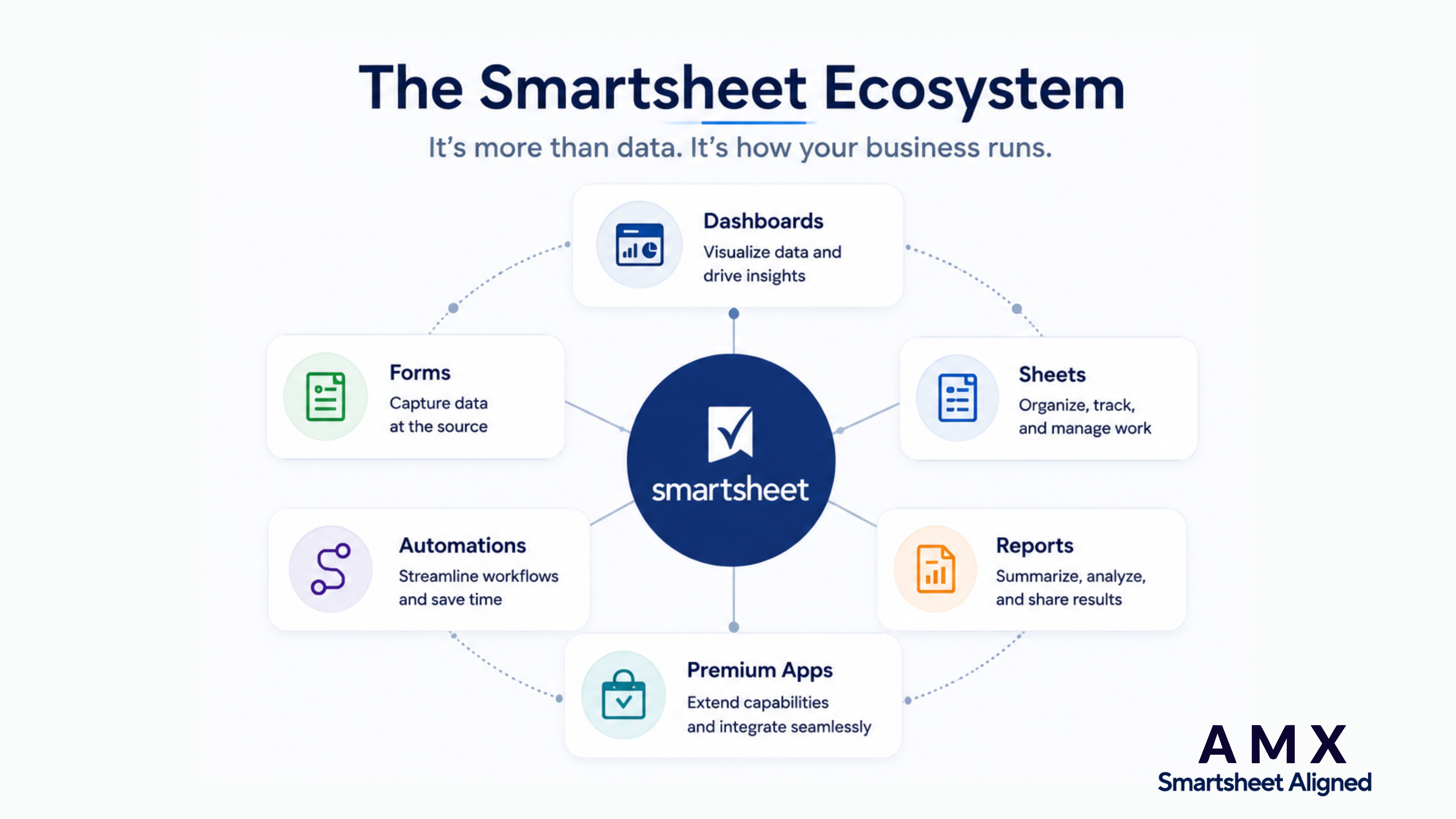
Smartsheet environments often contain hundreds or even thousands of interconnected assets, including sheets, reports, dashboards, forms, automations, and workspaces. During migration, organizations must ensure that all data remains accurate and complete while preserving the relationships between these assets. Even minor inconsistencies can affect reporting accuracy, operational workflows, and decision-making.
Maintaining business continuity also requires preserving the automated workflows that organizations rely on to support critical business processes, including approval requests, notifications or status updates. During migration, these workflows must be carefully assessed, validated, and re-established within the new environment to ensure they continue operating as intended. Without thorough planning and testing, organizations risk disrupting day-to-day operations, delaying critical processes, and reducing overall productivity.
User access, permission management, and compliance controls require careful attention throughout the data migration process. Ensuring that the right people retain access to the right information can be particularly complex in large organizations with multiple departments, regions, and governance requirements. Sharing permissions, user roles, and access controls must be reviewed and migrated accurately while aligning with regional compliance policies and internal security standards.
At the same time, while regulatory compliance is often one of the primary reasons for migrating data to the EU region, the migration process itself must also be conducted in a compliant manner. Companies have to ensure that sensitive information is handled securely, internal governance requirements are followed, and appropriate levels of auditability and traceability are maintained at every stage. This is especially important for regulated industries, where compliance may need to be demonstrated during and after the migration through internal reviews or external audits.
Successfully migrating Smartsheet data therefore requires far more than technical expertise. It demands a well-defined strategy that balances regulatory requirements, business continuity, data integrity, user adoption, and operational efficiency while ensuring day-to-day operations continue uninterrupted. Without the right approach, organizations risk disrupting critical business processes, breaking dependencies between Smartsheet assets, and creating unnecessary complexity for end users.
Simplifying EU Region Migration with Specialized Solutions
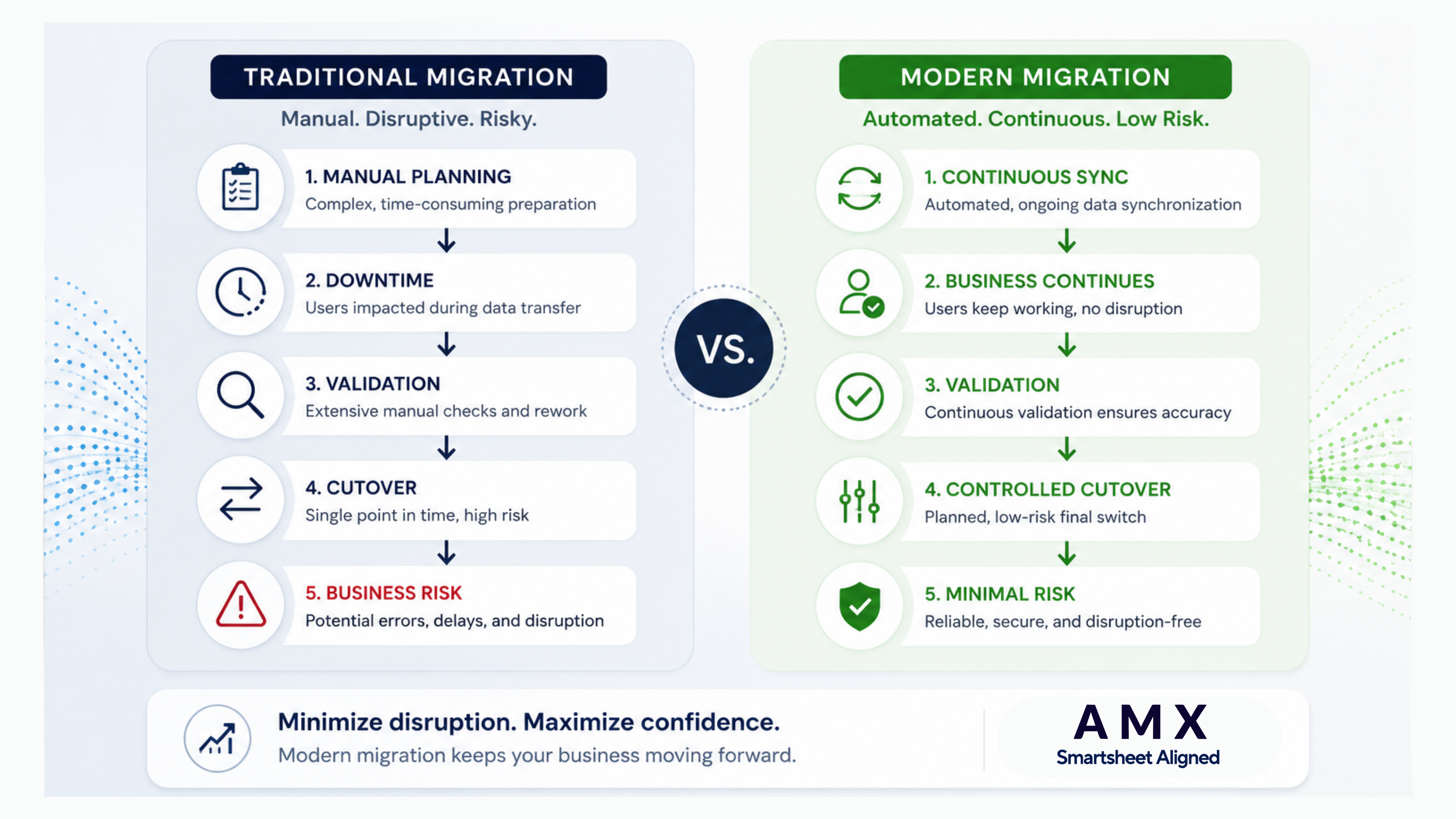
Migrating a Smartsheet environment between regions has become significantly easier than it was just a few years ago. Today, organizations using core Smartsheet capabilities can migrate an entire environment with very few limitations, making what was once a complex and highly manual process largely automated. However, a successful migration still requires careful planning to validate the migrated environment, preserve business continuity, and ensure users experience a seamless transition. In addition, configurations for Premium Apps, including solutions such as Control Center, Data Shuttle, DataMesh, Dynamic View, and Bridge, must currently be recreated manually after the migration.
To simplify these remaining challenges and minimize the aforementioned risks, organizations are increasingly leveraging specialized migration solutions such as MirrorSpark. Rather than simply moving data from one region to another, MirrorSpark analyzes workspace structures, identifies dependencies between sheets, reports, dashboards, forms, automations, and other assets, helping preserve the integrity of the overall Smartsheet ecosystem. A key advantage of MirrorSpark is its ability to maintain continuous synchronization between the source and destination environments throughout the migration. This allows users to continue working while data remains accurate, up to date, and fully connected, eliminating the need for lengthy downtime or disruptive cutover periods.
By automating complex migration activities, preserving relationships, workflows, permissions, and dependencies, and significantly reducing manual effort, MirrorSpark enables organizations to migrate with confidence while maintaining business continuity, data integrity, and compliance throughout the migration process.
 Use the right arrow to view all images.
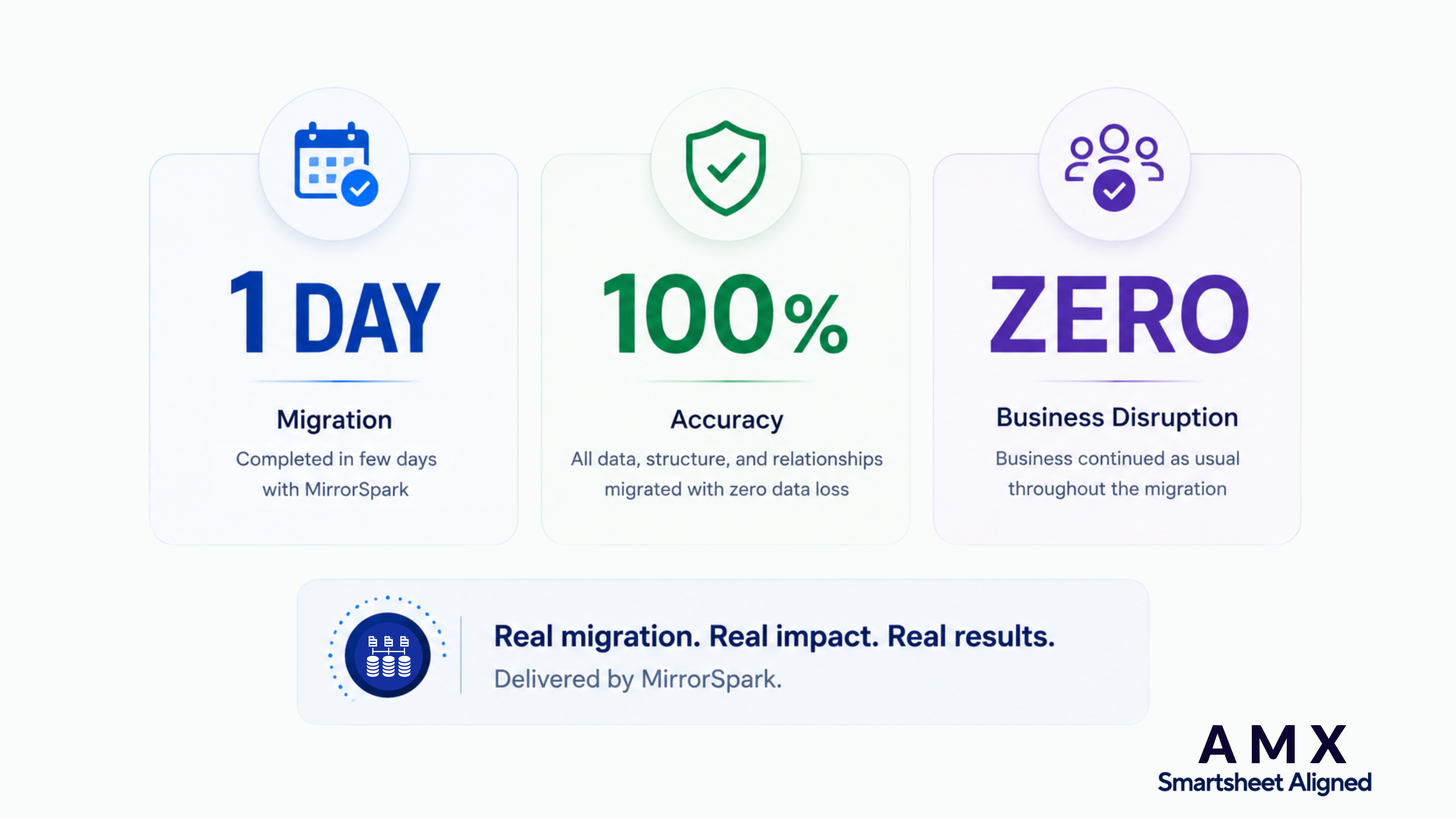
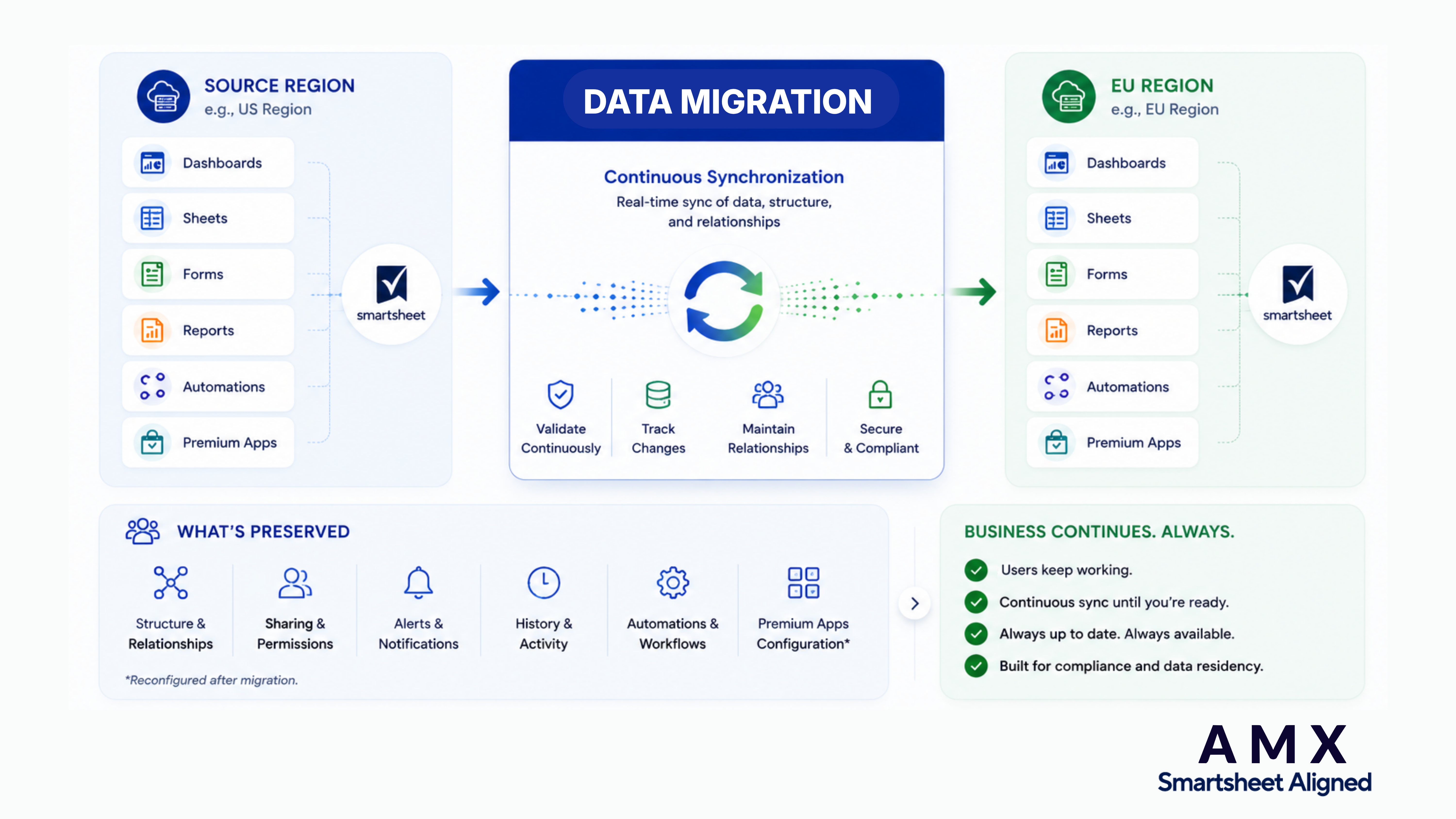 Successful migration ensures a seamless migration of your entire Smartsheet ecosystem and preserves relationships - not just data.
Example Use Case: A Faster, Safer Path to Smartsheet Regional Migration
Consider a global manufacturing organization operating across Germany, France, and Italy that decided to migrate its Smartsheet environment to the EU region to better align with internal governance requirements and customer expectations around data residency. Over several years, the company had built a highly integrated Smartsheet ecosystem supporting engineering change requests, capital projects, supplier onboarding, and day-to-day manufacturing operations. The environment included more than 1,200 sheets, 150 reports, 80 dashboards, dozens of interconnected workspaces, numerous business-critical automations, and Premium Apps such as Control Center and Data Shuttle, all working together to support business-critical processes across multiple departments and regions.
Rather than manually rebuilding relationships between assets or coordinating lengthy migration windows, the organization used MirrorSpark to analyze its environment, preserve dependencies, synchronize data throughout the migration, and automate much of the validation process. At the same time, Premium App configurations were recreated as part of a structured migration plan, ensuring that business processes continued to operate as expected once the migration was complete.
To further reduce risk, the organization leveraged Virtual Smartsheet Admin capabilities to perform automated structural and visual validation, quickly identifying any discrepancies between the original and migrated environments before users were transitioned to the new region. As a result, the organization completed its migration with minimal disruption to business operations while maintaining data integrity, preserving critical relationships, and significantly reducing the effort required from administrators and business users. Instead of spending weeks manually rebuilding and validating interconnected assets, teams were able to focus on governance, user adoption, and ensuring a smooth transition to their new regional environment.
Click the image to watch the video.
Closing Remarks
As Smartsheet migration capabilities continue to evolve, moving an environment between regions no longer needs to be a lengthy or resource-intensive project. Specialized solutions such as MirrorSpark enable organizations to maintain continuous synchronization between source and destination environments throughout the migration, allowing users to continue working while the transition takes place in the background. By preserving data integrity, accelerating validation, and minimizing disruption to business operations, organizations can confidently migrate to a new region without sacrificing productivity or business continuity.
Planning a Smartsheet EU Region Migration?
AMX Consulting helps organizations assess migration readiness, develop migration strategies, and deliver seamless regional migrations using proven methodologies and specialized solutions.
Contact us to discuss your migration requirements.
Save the Date - Join our exclusive webinar on Successful Smartsheet EU Region Migration
📅 16 September | 10:00 CEST
Register your interest today to be among the first to receive the webinar registration link.
———————————————————————————————————————————————————
* Although this blog focuses on migration to the Smartsheet EU Region, the same proven migration approach can be applied between any supported Smartsheet regions. Regardless of the destination region, successful migrations require careful planning, validation, and the right tools to minimize risk and business disruption.